
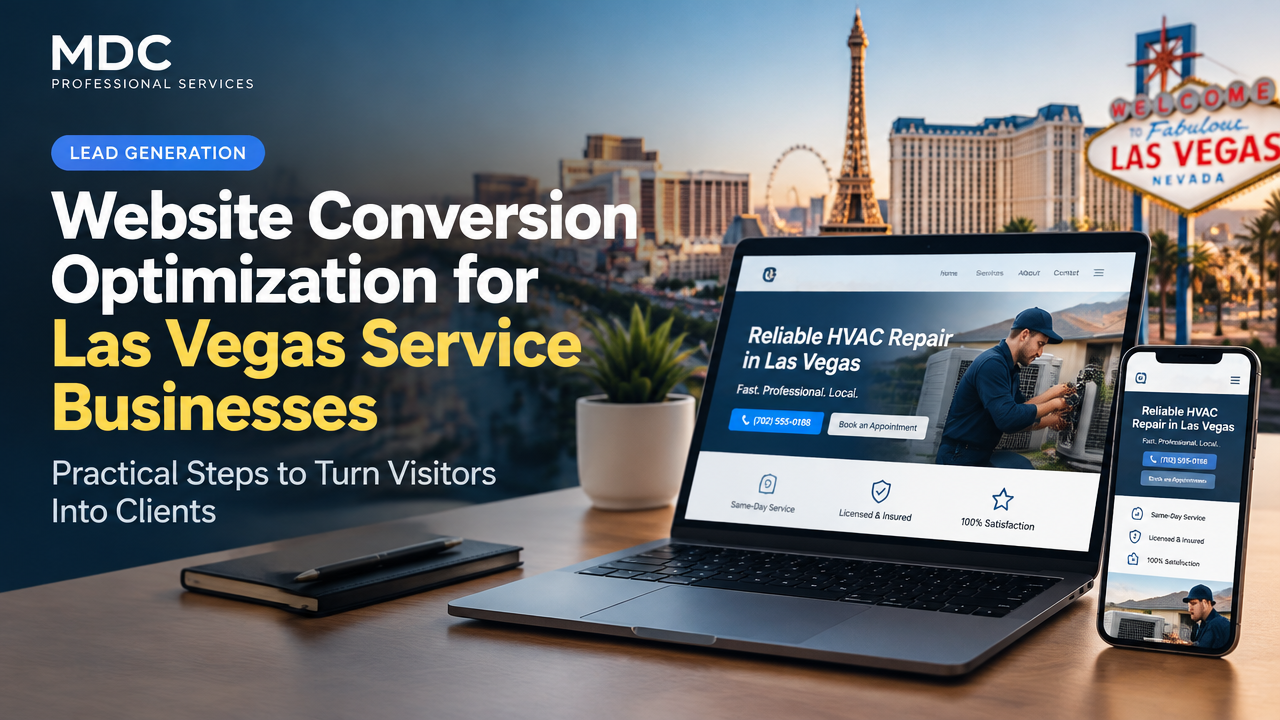
Service businesses in Las Vegas, Nevada — from home services and healthcare to professional consulting, hospitality, and trade contractors — depend on a steady stream of qualified local leads. Website conversion optimization (CRO) means turning more of the traffic you already have into booked appointments, phone calls, or qualified inquiries. This guide provides practical, non‑technical steps tailored to Nevada service companies that you or your web team can implement within 90 days.
Understand Who Visits Your Site and Why
Before making changes, collect basic data on visitor intent, landing pages, and how visitors currently convert. Focus on:
- Primary search terms and intent (e.g., “Las Vegas HVAC repair,” “Summerlin estate planning”).
- High-traffic entry pages: homepage, service pages, blog posts, and Google Business Profile listings.
- Behavior patterns: bounce rate, pages per session, time on page, exit pages, and current conversion paths (contact form, phone click, booking form).
Use Google Analytics 4 (or another analytics tool) plus heatmaps or session recordings when possible. If your site runs on WordPress, use reliable plugins for analytics event tracking (phone click events, form submissions). Document baseline conversion rates by page and referral source so you can measure progress.
Optimize Landing Pages and Calls To Action
For service businesses, each major service and each primary service area should have a distinct landing page that addresses intent and removes friction. Key elements:
- Headline matching search intent (service + location), e.g., “Emergency AC Repair — Las Vegas”.
- Short, benefit-focused opening: what you do, who you serve, and your main differentiator (same‑day service, licensed technicians, warranty).
- One dominant CTA above the fold — clickable phone number and a short contact or booking button.
- Secondary CTAs for visitors who need more info (download a checklist, estimate request, FAQ anchor links).
- Clear pricing cues or ranges when appropriate (or an explanation of how estimates/quotes work).
Practical copy tips: keep sentences short, use bullets for benefits, and put the highest-value information near the top. For WordPress sites, page builders (when used well) allow you to create focused landing templates that are easy to replicate across services.
Design and Copy Principles That Improve Conversion
Design and copy are not separate from conversion — they’re the primary drivers. Apply these principles:
- Clarity over cleverness: Visitors decide quickly; clear offers and CTAs beat creative ambiguity.
- Visual hierarchy: Make the CTA visually dominant, use headings and bullets, and break long content into sections.
- Social proof near the CTA: a short testimonial, star rating, or recent project image helps reduce hesitation.
- Limit choices: reduce navigation distractions on landing pages (consider a slim header and a single-path layout for paid campaigns).
- Accessibility: ensure tappable elements, sufficient color contrast, and readable fonts to avoid losing mobile users.
Improve Mobile Speed and UX — Las Vegas Visitors Are On The Move
Many potential clients search while commuting or standing at a job site. Prioritize:
- Fast load times (single-digit seconds). Compress images, defer nonessential scripts, enable caching, and use a reliable host.
- Large tappable CTAs and visible phone links; implement click-to-call for mobile visitors.
- Short forms optimized for mobile (auto-fill where possible, numeric keyboards for phone fields).
- Test pages on multiple devices and networks to simulate real-world conditions in Las Vegas neighborhoods.
If you use WordPress, choose a performance-focused theme, limit heavy plugins, and consider a CDN and image-optimization plugin to reduce load times.
Integrate Google Business Profile and Local Listings
Local signals feed conversion. Your Google Business Profile (GBP) and local citations create expectation and trust before a visitor even reaches your site. Actions to take:
- Ensure NAP (name, address, phone) consistency between your site, GBP, and key local directories.
- Embed a link to your GBP and recent reviews on service pages.
- Use local photos and examples on landing pages where relevant (neighborhood names, service area map).
- Keep hours, holidays, and special service notes up to date in GBP to reduce friction for callers.
Use Trust Signals and Local Proof
Service buyers need confidence. Add trust elements that matter locally and legally:
- Recent, real customer testimonials with general location indicators (e.g., “Summerlin homeowner”).
- Short case studies or before/after photos for visual services (cleaning, landscaping, remodeling).
- Certifications, licenses, and association badges — ensure you can verify any claims.
- Clear contact information, local address, and operating hours; link to your Google Business Profile for validation and directions.
Track Revenue Impact and Lead Quality
Raw lead counts are useful, but revenue and lead quality tell the business story. Track:
- Lead source (organic, paid, GBP, referral) and page of origin.
- Outcome from each lead: booked appointment, estimate scheduled, sale closed (capture in CRM or spreadsheet).
- Average value per lead and conversion-to-sale rate by source to prioritize efforts.
Even simple UTM tagging on marketing links and a basic CRM note for source will help calculate ROI for landing pages and A/B tests.
Track, Test, and Iterate — Practical A/B Tests
Small tests can produce measurable gains if you set clear goals and measure carefully. Recommended experiments and practical guidelines:
- CTA copy and color: “Book Now” vs “Get a Free Estimate”; high-contrast colors vs brand colors.
- Form design: single short form vs two-step form that asks for minimal info first.
- Page layout: hero image vs no-image headline; testimonial above the fold vs below the fold.
- Test duration: run tests until you have a reasonable sample size (aim for a minimum of several hundred visitors per variant or use a sample-size calculator to estimate needed traffic).
Use event tracking in Google Analytics 4 and link results to business outcomes (calls, bookings). If traffic is low, focus on high-impact manual changes (headline clarity, fewer form fields) rather than long A/B tests.
Practical Conversion Optimization Checklist
| Area | Action | Priority |
|---|---|---|
| Analytics | Confirm page-level tracking, phone click and form events, connect to GA4 | High |
| Landing Pages | Create service + location pages with one dominant CTA | High |
| Mobile | Enable click-to-call, shorten forms, test on major phones | High |
| Speed | Compress images, enable caching, audit plugins/third-party scripts | Medium |
| Forms | Test reduced fields, two-step flows, and inline validations | Medium |
| Trust | Add recent testimonials, link to GBP and display licenses | Medium |
| Testing | Run A/B tests for headlines, CTAs, and form length | Medium |
| CRM | Capture lead source and outcome for revenue tracking | High |
Implementation Roadmap for the Next 90 Days
Week 1–2: Audit analytics, tag top landing pages, and fix obvious mobile/CTA issues. Assign owners for each task.
Week 3–6: Build or refine service and location landing pages, add trust elements, and simplify forms. Implement fast wins on the homepage and top 3 service pages.
Week 7–10: Start A/B tests on CTAs and forms, implement speed optimizations, and track results. Integrate GBP updates and local listing checks.
Week 11–12: Consolidate learnings, scale winning variations to other pages, and create a quarterly testing plan tied to revenue goals.
When To Call a Pro
If conversion lift is a business priority but internal resources are limited, a focused engagement that includes landing page design, UX improvements, and testing setup often delivers the fastest ROI. Start small — redesign a high-value service page or a paid campaign landing page, then scale. For WordPress sites, consider professional theme tuning, plugin audits, and performance optimization to reduce long-term overhead.
Frequently Asked Questions
Conclusion
Conversion optimization is a continuous, measurable process that delivers business value when tied to revenue and lead quality. For Las Vegas, Nevada service businesses, the biggest gains typically come from aligning landing pages to local search intent, simplifying mobile interactions, adding local trust signals like a strong Google Business Profile, and running short, well-measured tests. Start with a single high-value page or campaign, measure responsibly, and scale the winners. If you want help planning or implementing these steps, MDC Professional Services provides targeted design, local SEO, and WordPress optimization tailored to Nevada businesses.
Ready to start a project?
Schedule a consultation with MDC Professional Services to discuss your website, SEO, branding or digital growth project.

MDC Editorial Team
Practical business, technology and growth insights from MDC Professional Services in Las Vegas, Nevada.
0 Comments